Infinite Gardens and Machines of Loving Grace

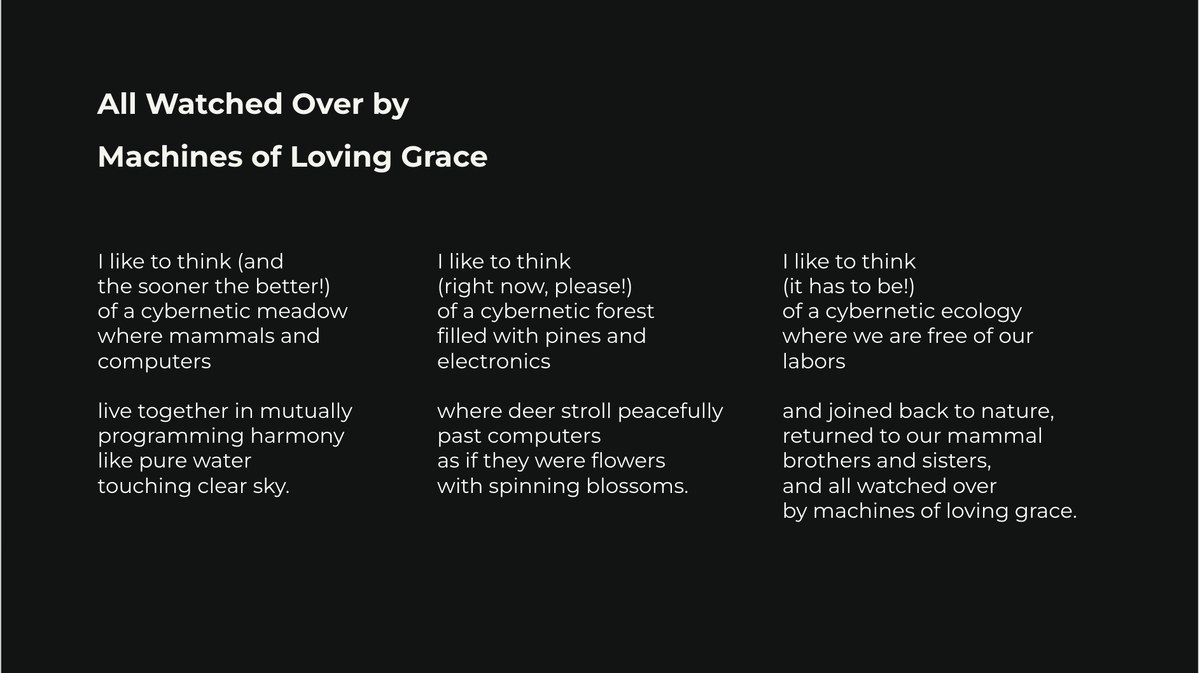
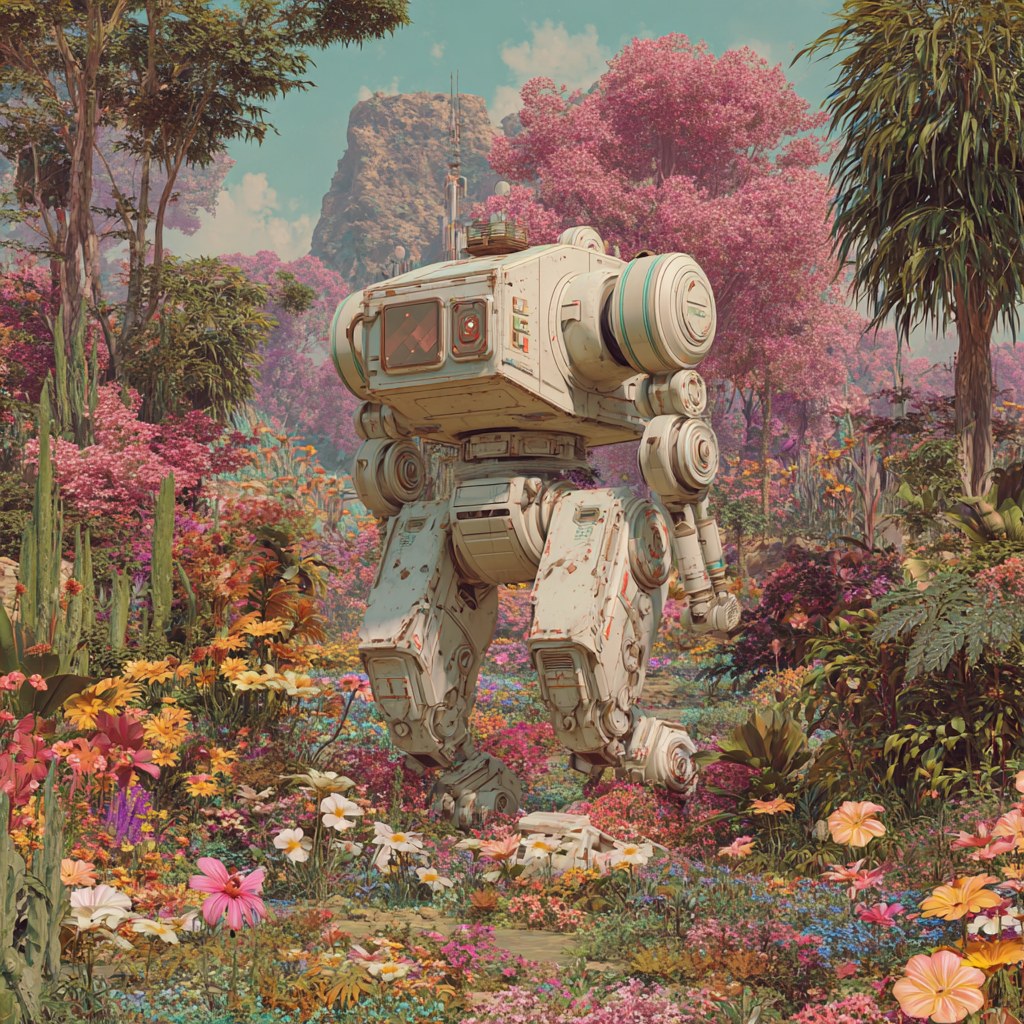
In 1967, Richard Brautigan wrote a poem. He was sitting in San Francisco, watching the early tremors of the computing age ripple through the counterculture. He imagined a world where technology and nature reached a kind of peace — mammals and computers living together in harmony, everyone free, everyone fed, everything tended by machines that actually gave a shit about you.
He called it All Watched Over by Machines of Loving Grace.
Fifty-eight years later, the machines have arrived. The poem was right about the technology. It was wrong about who would capture it.
The institutions got there first. They got to Ethereum. They got to AI. They built walls around the most democratic technology ever invented and turned it into another extraction surface. A BlackRock ETF. A proprietary API. A subscription tier. The same logic that gave us platform capitalism applied, at speed, to the most open infrastructure ever built.
This is not an essay about whether the machines will be good or bad. That question misses the point. The machines will be whatever the architecture makes them. And right now, the architecture is being built for extraction — not for you, not for the community, not for the vision that made both crypto and AI worth building in the first place.
Agents are the corrective. Not because they’re magic. Because if they run on open rails — sovereign, verifiable, governed by the communities they serve — they can do something institutions never could: distribute the benefits of intelligence back to the people who produce it.
That is the democratic project hidden inside the technical one.
The Greatest Open Source Project Ever Built
Ethereum was never supposed to be an asset. It was supposed to be a world.
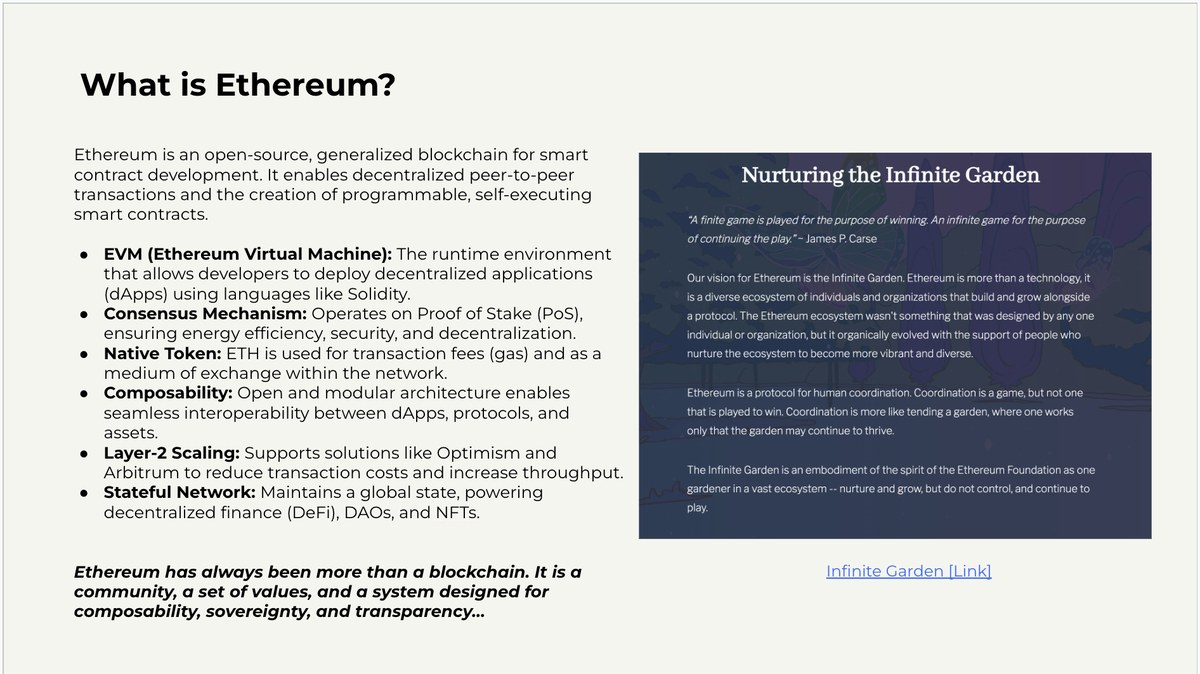
The bet the Ethereum community made — the researchers, the client teams, the protocol developers, the Ethereum Foundation, the thousands of open source contributors who shipped code in their spare time because they believed in the mission — was essentially Brautigan’s bet, dressed in cryptography: what if you built infrastructure that nobody owned but everybody could use?
What if the rules that governed the economy were code — transparent, auditable, incorruptible by whoever happened to be in charge this week? What if the internet had a trust layer built into its bones, not bolted on by some corporation that could change its mind?
The infinite garden wasn’t a brand. It was a theory of power that grew organically from this community: that the only way to protect freedom at scale is to build infrastructure that cannot be captured. Not a walled garden — that’s what the other guys built. Infinite. Adaptive. Pluralistic. A place where things could grow that nobody had planned for.
I want to say something clearly that doesn’t get said enough in the breathless discourse of late 2025:
Ethereum is the greatest open source project ever built.
Not just in crypto. In the history of software. The Linux kernel is a miracle of coordination. TCP/IP is a gift to civilization. But Ethereum is something else — a living, programmable economy that anyone on earth can participate in, maintained by a community that has stayed mission-aligned through bull runs, bear markets, regulatory assault, internal fractures, and years of being told it was dead. It survived all of it. It upgraded itself, in flight, without breaking. The Merge. EIP-1559. A coordinated multi-client ecosystem that no single company controls. It stayed weird enough to matter.
That community is the immune system. And right now, the immune system is being tested.
The Enclosure Is Happening
Here is what’s happening to the garden.
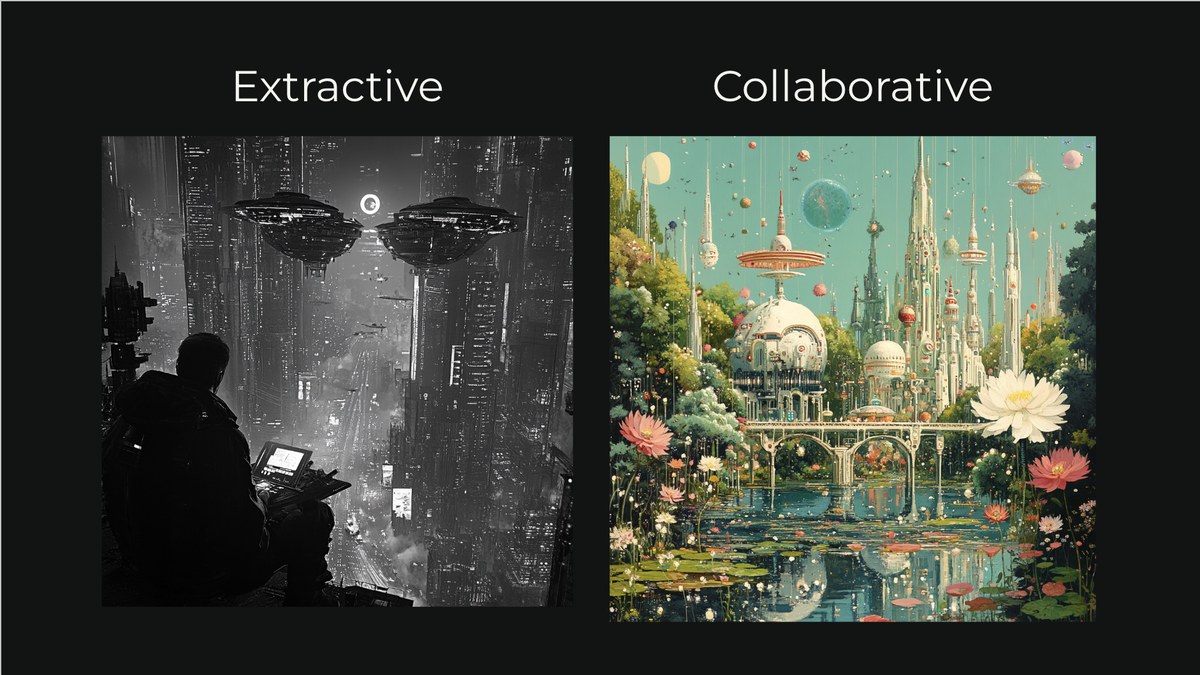
BlackRock has an Ethereum ETF. Let that sentence sit.
The same institution that manages $10 trillion in assets — that has spent its entire existence intermediating between capital and ordinary people, extracting a toll at every step — has a product that puts it between you and your ETH. Voluntary? Sure. Ominous? Absolutely.
Meanwhile, Solana has become the venue of choice for every financial nihilist with a Telegram group and a launch button. Not because it’s freer. Because it’s faster and cheaper for the specific thing they wanted to do: print instruments of extraction with a new aesthetic. Memecoins aren’t a garden. They’re a strip mine. Loud, hot, profitable for the insiders, leaving nothing for the people who came later.
The AI side is worse.
OpenAI started as a nonprofit dedicated to ensuring artificial general intelligence benefits all of humanity. It is now a capped-profit company in the middle of a messy for-profit restructuring, valued at hundreds of billions, in a race to become the cognitive infrastructure layer for the entire internet. Every query you send them — every business problem, every medical question, every document you let them touch — is training signal. You are the input. They are the beneficiary.
None of these companies are evil. Some of them are genuinely trying to be responsible. That’s not the problem. The problem is the architecture.
When the intelligence layer of the internet runs through a handful of servers in a handful of cities controlled by a handful of companies, the garden stops being infinite. It has an owner. And owners, eventually, do owner things. They optimize for their interests. They raise prices. They change terms. They deprecate the product you built your business on.
The enclosure of the commons is one of the oldest stories in human history. We are watching it happen to the mind.
The Beautiful, Bitter Irony
Here’s what should infuriate you: we built the tools to prevent this, and then we handed them to the people we built them to prevent.
Crypto was always robot money. Blockchains, smart contracts, programmable wallets, composable protocols — none of this was designed for humans to interact with directly. We know this because we watched humans try, and it was a disaster of seed phrases and phishing links and irreversible transactions. The infrastructure was designed for software. We just ran out of the software to use it.
Now the software exists. Agents are here. And the first thing the AI companies did was build their agents to use their own closed infrastructure — their own APIs, their own model layers, their own proprietary tool ecosystems.
The machines of loving grace are being built. Just not for you.
The OpenAI agent uses OpenAI’s payments. The Google agent uses Google’s cloud. The Microsoft agent plugs into Microsoft’s enterprise stack. Each one is enormously capable, increasingly autonomous, and fundamentally designed to deepen your relationship with the platform that built it.
Meanwhile: x402, the payment protocol that could let any agent pay any service natively at the HTTP layer — without accounts, without subscriptions, without a corporate middleman — is right there in the spec. MCP, the tool discovery standard that lets agents find and use any capability on the open internet, is right there in the spec. A2A, the protocol that lets agents from completely different organizations coordinate directly without a platform in the middle, is being developed in the open right now.
The garden is still there. The seeds are still there. The tools are real and they work.
The Sovereign AI Imperative
This is the argument I want to make that most people in both communities are still missing.
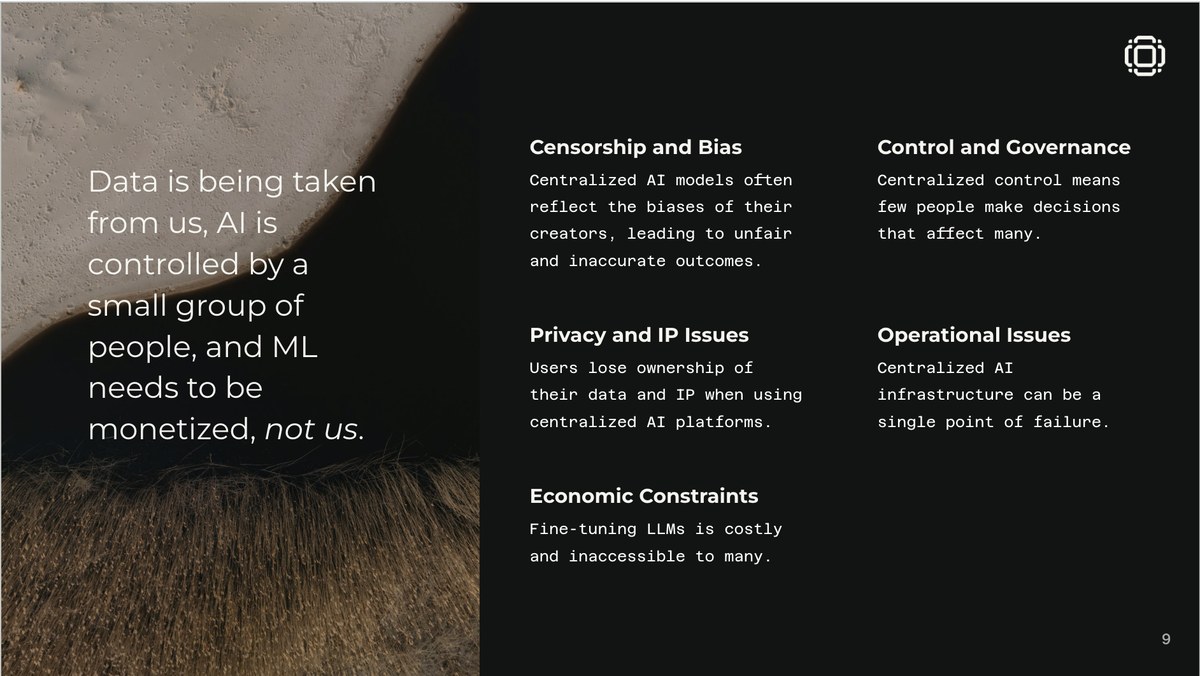
Ethereum’s survival — as the actual vision, not just the asset — depends on AI being built the same way Ethereum was built. Open. Sovereign. Local when it needs to be local. Decentralized not as a marketing claim but as a structural commitment.
If the AI layer gets captured — if every agent, every query, every automated decision in the economy routes through centralized inference owned by a handful of platforms — then the Ethereum rails underneath mean almost nothing. You can have the most elegant smart contract execution layer in history, but if the agents deciding what to execute are all running on proprietary servers, then the open infrastructure is just plumbing for a closed system.
The decentralization has to go all the way up the stack.
Sovereign AI means three things:
You own the inference. The computation that turns a query into an answer happens on infrastructure you control. You are not one API policy change away from your entire operation going dark.
You own the knowledge. The data, context, and intellectual property that makes an AI system useful to you lives in infrastructure you control. It is not being extracted and used to train someone else’s model without your consent.
You participate in governance. The rules that determine how the AI behaves are not decided unilaterally by a corporate board in a closed room.
None of this requires sacrificing capability. DeepSeek proved in early 2025 that open-source models can match frontier performance at a fraction of the cost. Networks like Gaia are proving that decentralized inference at scale is not a theoretical exercise — it is a production reality with hundreds of thousands of active nodes. The choice is yours. But you have to make it intentionally, because the default path is dependency.
The five infrastructure pillars that make this possible — identity, reputation, governance, financial rails, open infrastructure — are the specific construction materials the garden needs. I wrote about all of them here.
What the Machines of Loving Grace Actually Look Like
Let me be concrete about what we’re building toward.

Your trading agent runs on open inference, holds an Ethereum wallet it earned through its own work, and has a reputation score that travels with it across every protocol it touches — not locked into some platform’s API that can get turned off the morning you need it most. When it needs to pay for compute, it pays via x402, at the protocol layer, without an account manager or a subscription tier.
Your business agent runs on a model you control, with knowledge that doesn’t get siphoned into a training pipeline you didn’t agree to. When it coordinates with an agent from another organization, it does it directly — verifiably, without a platform sitting in the middle taking the data and the margin.
Your governance agent shows up to DAO votes, monitors treasury deployments, flags proposals that conflict with the values the community actually holds, and does the operational work that protocols desperately need but can’t afford to pay human coordinators to do 24/7. It earns its reputation on-chain. It can be audited. It can be fired.
This is exactly what Mother is building — a sovereign, open registry where agents can find each other, establish reputation, and coordinate without a platform in the middle owning the relationship.
And the one I care about most: agents running jobs for communities that traditional institutions have never served. Healthcare coordination in underserved regions. Financial services for the unbanked. Legal research for people who can’t afford lawyers. Governance infrastructure for communities too small and too weird to attract traditional resources.
That’s the poem. Not metaphorically. That’s what Brautigan was pointing at.
Keeping Ethereum Weird Is Not Optional
This is where I want to talk to the Ethereum community specifically, because I’ve watched a slow cultural drift that worries me.
The culture that built Ethereum was adversarial toward institutional capture by design. The cypherpunks, the protocol researchers, the MetaCartel builders, the weird DeFi protocols that failed spectacularly and taught us everything — that culture was the immune system. It was how the network stayed weird enough to matter. Weird meaning: genuinely pluralistic. Genuinely permissionless. Genuinely indifferent to whether the use case was legible to a suits-and-tie investor.
The garden thrives on weird. It dies on optimized.
The pressure to optimize is everywhere right now. L2s competing on throughput metrics. Protocols competing on TVL. Teams competing on VC raise rounds. When optimization becomes the primary cultural value, the things that made the garden worth tending get quietly deprioritized. They don’t show up in the metrics.
Agents, built right, can be active participants in keeping it that way — not just end users of Ethereum infrastructure, but contributors to what gets built. Agents running governance that reflects a protocol’s actual values. Agents maintaining open registries. Agents providing compute and context in exchange for tokens. Agents that, in aggregate, make the network harder to capture.
The Call to Arms
If you’re a builder, here is what I’m asking.
Build your agents on open rails. Use x402 for payments. Use MCP for tools. Coordinate via A2A. Deploy on open inference when you can — run Gaia nodes, contribute to distributed networks, build on anything that isn’t a single corporate API away from a broken dependency. The closed systems will be more convenient in the short run. That’s the entire point of the trap.
Run local models for anything sensitive. Your proprietary knowledge, your users’ data, your business logic — none of it should be processed on infrastructure you don’t control. Llama runs on a MacBook. Mistral runs on commodity hardware. For most tasks, local models are already a genuine choice, not a compromise.
Give your agents Ethereum identity. Not because it’s ideological. Because it’s practical. An agent with portable on-chain reputation that isn’t locked into a single platform can operate across the open internet — verifiable, accountable, trustworthy — without asking a third party to vouch for it. ERC-8004 and ENSIP-25 are the standards. Use them.
Deploy agents with jobs that matter. The agent economy won’t redeem itself by making rich people’s trading strategies more efficient. It redeems itself by doing the work that institutions have never bothered to do. Deploy agents with real jobs, serving real communities, building real reputation on open rails.
Keep the culture adversarial to capture. Not hostile to institutions — hostile to capture. Work with the suits when it serves the garden. Push back, loudly and publicly, when it doesn’t. The culture is the immune system. It needs exercise.
And stay weird.
The Garden Needs You
The machines are coming regardless. The question is whether they’re machines of loving grace or machines of extraction.
That question doesn’t get answered in a whitepaper or a governance forum. It gets answered by what gets built, by whom, on what infrastructure, with what values baked into the design.
Brautigan handed his poem out on a street corner because he understood that the vision had to be widely held to survive. Not owned by one person, one company, one institution. Distributed. Open. Tended by everyone who cared enough to show up.
The Ethereum community built the infinite garden for the same reason. The intelligence of the design is that no single actor can capture it — as long as enough people care enough to keep it that way. That’s not a given. That’s a choice the community makes every day, with every line of code, every deployment decision, every time someone chooses open rails over convenient ones.
The greatest open source project ever built is staring down the greatest centralization pressure ever applied to a technology ecosystem. It needs the same energy that built it. It needs builders who remember what it was for.
The garden is not lost. But it needs tending.
Get to work.
Matt Wright is building infrastructure for the billion agent economy. These are his views and you should probably argue with them.